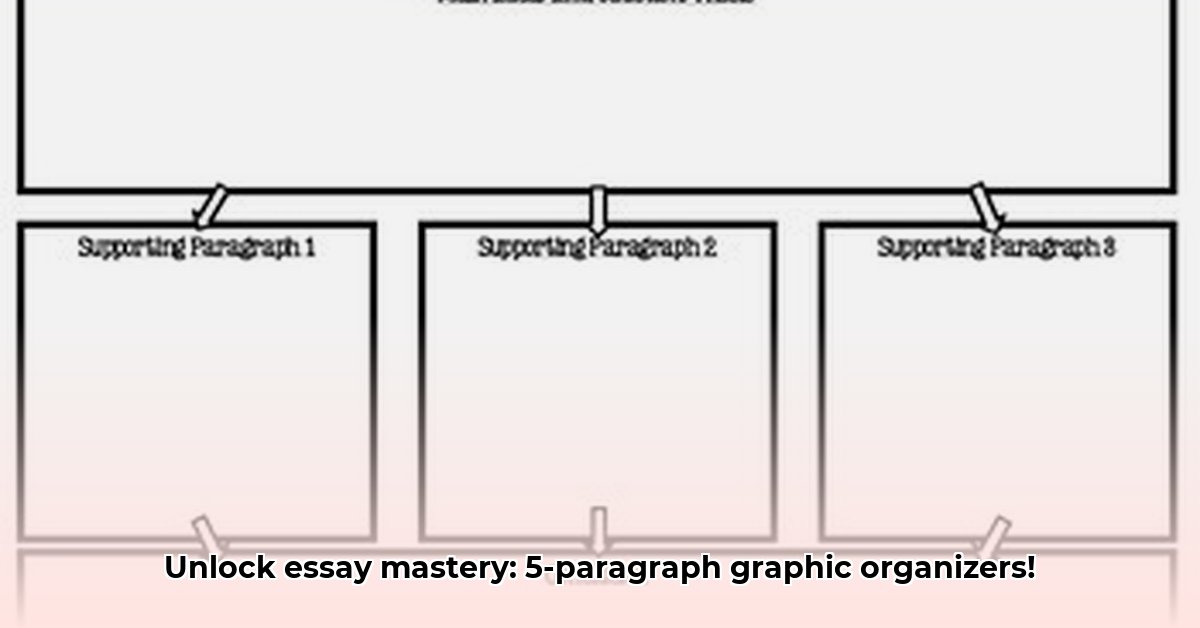
Feeling overwhelmed by essay writing? Imagine having a blueprint to guide you through the process, ensuring a clear, well-structured, and compelling final product. That's the power of a five-paragraph essay graphic organizer. This guide will equip you with the knowledge and practical steps to master these invaluable tools, transforming essay writing from a daunting task into a manageable and even enjoyable experience.
Understanding the Five-Paragraph Essay Structure
The five-paragraph essay is a foundational structure, a time-tested method for presenting information logically and concisely. It's a perfect starting point for both novice and experienced writers, providing a clear framework to prevent rambling and ensure complete coverage of your argument. This structure, like a well-built house, comprises a solid foundation (introduction), supporting walls (body paragraphs), and a strong roof (conclusion).
The Components of a Five-Paragraph Essay
Introduction: Begin by grabbing your reader's attention with a compelling hook (an interesting fact, quote, or question). Then, provide necessary background information on your topic, leading smoothly to your thesis statement – the central argument your essay will support.
Body Paragraphs (Three): Each paragraph focuses on a single supporting point for your thesis. Each should contain a topic sentence (the main idea), supporting evidence (facts, examples, quotes), and a concluding sentence summarizing the paragraph’s contribution. Think of these as the pillars supporting your argument's weight.
Conclusion: Summarize your main points, restating your thesis in a new way to avoid repetition. Offer a final perspective or an insightful closing thought. This reinforces your argument and leaves a lasting impression on the reader.
Why Use a Graphic Organizer?
Would you build a house without blueprints? Just as blueprints guide construction, graphic organizers provide a visual roadmap for your essay. They are invaluable for:
- Pre-Writing Planning: They help organize your thoughts before you write, preventing mid-essay confusion and ensuring a logical flow of ideas.
- Idea Visualization: Visualizing the structure of your argument simplifies the writing process, particularly for complex topics.
- Enhanced Clarity and Cohesion: By mapping your points visually, you create a cohesive narrative, reducing ambiguity and strengthening your argument.
Did you know? Studies show that students using graphic organizers demonstrate significant improvements in essay organization and overall essay quality.
Exploring Different Graphic Organizer Styles
Several types of graphic organizers cater to different learning styles and essay complexities. Here are three popular choices:
| Type of Organizer | Description | Best Suited For |
|---|---|---|
| Linear Outline | A simple list of points, ideal for straightforward essays. | Beginners, essays with clear, linear arguments. |
| Box-and-Arrow Diagram | Uses boxes to represent ideas and arrows to illustrate their relationships. | Essays requiring a clear demonstration of cause and effect. |
| Mind Map | A visual representation of ideas branching from a central topic. | Brainstorming, complex essays with diverse interconnected ideas. |
Choosing the right organizer involves considering your personal preference and the complexity of your essay topic. Experiment to find what works best for you.
A Step-by-Step Guide to Using Graphic Organizers
Let's create a five-paragraph essay using a graphic organizer:
Step 1: Brainstorming (10-15 minutes): Jot down everything related to your essay topic. Don't worry about organization yet; focus on generating ideas.
Step 2: Thesis Statement Formulation (5 minutes): Craft a clear and concise thesis statement summarizing your main argument.
Step 3: Selecting Key Supporting Points (5-10 minutes): Choose three main points that strongly support your thesis.
Step 4: Organizing Your Graphic Organizer (10-15 minutes): Place your introduction components (hook, background, thesis) at the top, your three supporting points in the middle (one per body paragraph), and your conclusion elements (summary, final thought) at the bottom.
Step 5: Fleshing Out Details (20-30 minutes): Add specific details and supporting evidence (facts, examples, quotes) to each section of your organizer.
Step 6: Refining and Revising (10 minutes): Review your organizer for logical flow and completeness. Make adjustments where necessary.
Step 7: Essay Writing (30-60 minutes): Now, write your essay, using your graphic organizer as your guide.
Beyond the Basics: Adapting the Five-Paragraph Essay
The five-paragraph essay is a starting point. As your writing skills develop, you'll likely adapt this framework. You might add more paragraphs to explore complex themes or adjust the number of supporting points. The key is flexibility and clear communication of your ideas.
Dr. Emily Carter, Professor of English Composition, University of California, Berkeley, emphasizes that “the five-paragraph essay serves as a valuable foundation for building more complex writing skills. It’s a tool for understanding argumentation, not a rigid rule.”
Remember, the graphic organizer is a tool to enhance your writing process, not to confine it. By understanding and mastering these techniques, you can unlock the power of clear, organized, and persuasive essay writing.